Friday, March 9, 2012

Fermentation (this is not only about wine)


When I was pregnant with our older son, Harry, Steve planted a bunch of daikon radish in the garden with the idea to ferment it and turn it into pickled daikon, a Japanese delicacy. Luckily our attempt to ferment a baby turned out better than the daikon radish experiment, but it started us of on a path of fermentation and we have never looked back! 
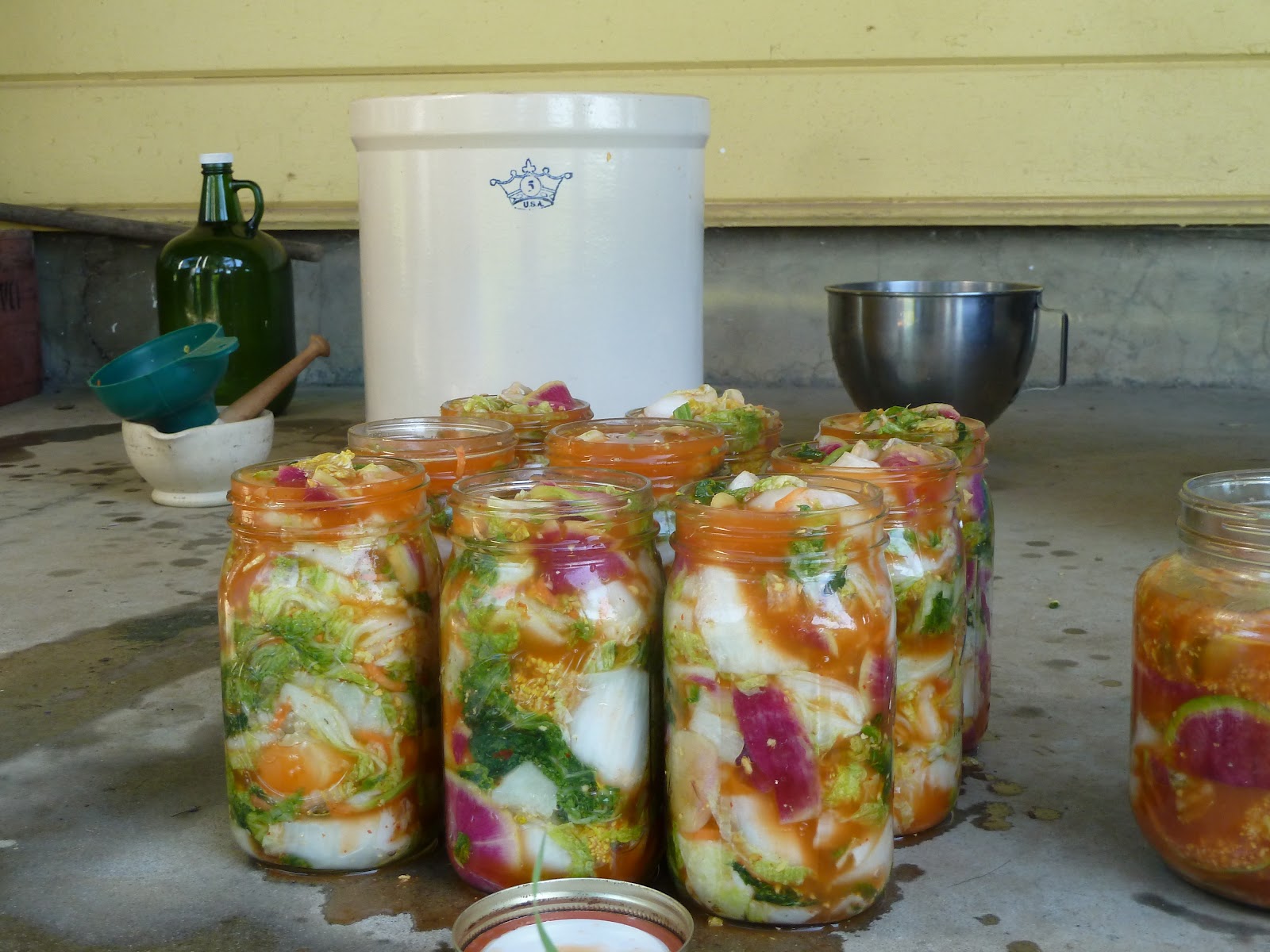
Making Kimchi
Soon after our first failed attempt at fermenting, we discovered a cookbook called Nourishing Traditions by Sally Fallon, where we learned that fermenting foods is not only an age-old way to preserve food, but that the process of fermentation actually makes the food more nutritious.
Different types of fermentation yield different results. With beer and wine, yeast ferments sugars and carbohydrates into alcohol. Another type of fermentation, called lacto-fermentation, uses a bacteria called Lactobacillus to ferment things like milk into yogurt. Malolactic fermentation, which is a type of Lactobacillus fermentation, is part of the secondary fermentation which some wine varieties, such as Chardonnay, go through (that's where Chardonnay can get it's butteriness).

It includes Napa cabbage and watermelon radish
Since we have a big garden, we are always trying to figure out easy, healthy ways to preserve the bounty. So over the years we have learned to successfully ferment the vegetables as a way to preserve them. By trial and error, we have gotten pretty good at making lacto-fermented sauerkraut, pickles, olives, and much more!

This past weekend, the cabbage was turned into sauerkraut and Kimchi (a spicy Korean type of sauerkraut) and the weekend before, we made pickled cauliflower (yum!). If you come by the house, you will almost always find something in the fridge that's been fermented. This might even include several experiments which are sometimes amazing, like green tomatoes, sometimes not, like the unripe nectarines. 

The best recipes for fermented veggies are from a book called Wild Fermentation by Sandor Katz. In his book, Katz reminds us that many of our favorite foods and drinks are fermented including bread, cheese, wine, beer, chocolate, coffee, tea, pickles, sauerkraut, kimchi, miso, soy sauce, vinegar, and buttermilk.
the finished product
And be sure to check out his recipe for the Best Sauerkraut Ever!


Jill Klein Matthiasson

Friday, March 2, 2012

Balanced Wines and My Tasting with the Owner of DRC


I’m in a wine tasting group made up of a motley bunch of winemakers.  We meet once a month and this year the eight of us decided to focus our monthly tastings solely on the wines of Burgundy. We all love these wines, but feel tremendously ignorant about them.

By a crazy stroke of good fortune, we were lucky enough to be joined in our tasting group this month by Aubert de Villaine, the propietor of Domaine Romanee Conti. Domaine Romanee Conti (aka DRC) is considered by many to be the best wine in the world (and is definitely the most expensive), and Aubert is the owner and a legend in the business. In his mid-70s, he still is extremely passionate and fascinated with wine. He’s been making wine from the same vineyards for over 50 years, and he told us that he wishes he had a tasting group at home in Burgundy so that he could keep exploring wines other than his own in the way that we do with our tasting group!

One of the nuggets that he shared was the critical difference between “natural opulence and contrived opulence,” This ties into the concept of restraint—a restrained wine can still be opulent, but it is a natural opulence, an opulence that comes with the fruit, not the manufacturing. I’d never heard this verbalized, but as soon as he said it, I felt a huge “ah-ha,” since it confirmed what I’ve felt but hadn’t brought into focus in my mind.

Another nugget that he shared was importance of balance in wine. Aubert stressed that it is the small nuances that transport the wine into another world—the exercise of experiencing wine is about discovering those nuances in the wine—without balance the nuances can’t be detected.

It is really striking to me that the very few times that I’ve had the opportunity to taste with true legends of the industry, I’ve always been struck by their fascination and appreciation of  balanced wines.

The influential sommelier Raj Parr articulated the importance of balanced wines in his interview in the Wall Street Journal this past Saturday, where he uses our MATTHIASSON White Wine as an example and describes it as having..."racy minerality. Dry, long, great balance."

From different parts of the globe and different personal histories people in the wine business converge in their appreciation of wine. After spending the evening tasting with Aubert,, my opinion was reinforced that wine appreciation is not relative, and that our goal of creating singular wines with classical balance is the one and only way for us to make wines that will truly stand the test of time.

Steve

Tuesday, February 21, 2012

Learning by Doing

Viticulture (grape-farming) is an apprenticeship based discipline. The poet Gary Snyder said that with one’s education the four years after college are as important as the four year’s during college (paraphrasing). 

Jack in the vineyard
Our intrepid employee Jack Roberts is starting his third season with us—the first year collecting field data for my consulting company, and last year working for Matthiasson Family Vineyards on our tiny farming operation. For years we were too small to justify hiring an employee for the farming. We just didn’t have the cash, so I had to either do it myself, or get a crew in on a Sunday for the big pushes. Our farming and winemaking business is finally getting to the point where we could justify hiring an employee, thus we can now share the journey with Jack.

Since an apprenticeship is truly what’s required, it’s a tough balance between education and work output. There has been a lot of investment, and it’s so exciting and gratifying to see Jack’s proficiency develop. This year he pruned the Michael Mara vineyard in Sonoma, a super rocky and tough site, which makes for complicated pruning, in half the time it took him last year. And I feel that the vines are better pruned. The vines suffered a bit from being practiced on last year, but that’s part of the process. I shudder to think of the vineyards I screwed up while learning the trade of viticulturist—Jack hasn’t yet approached the level of inexperienced blunders that I’ve made—thankfully there haven’t really been any blunders at all.

bud break
So pruning, fixing trellises, operating equipment, fertilizing, killing gophers, spraying vines, racking wine, bottling, crushing grapes, delivering wine, packing jars of jam for the wine club, all these skills are being mastered, and not only making my life easier, but giving a lot of gratification at passing the long tradition of farming along to someone else.

And, our kids are next in line to gain that knowledge. Our son Harry asked me how to prune this winter, so we pruned the fruit trees and blackberries around the house. Next winter it will be the grapes.

Thursday, February 2, 2012

Getting the Wine in the Bottle

We started making wine in our garage in 1995. It was always small quantities, and bottling and labeling the wine wasn’t really a big deal.

Our biggest home winemaking project was in 2002. We made a barrel (25 cases) of Napa Valley Pinot Noir and a barrel of Napa Valley Cabernet Sauvignon. Bottling that wine was a much bigger deal, and I have to say, lots of fun. We had a big party and several friends were put to the hard work of bottling (and drinking) the wine, while Steve and I fed everyone. We called that wine “Chateau Mom and Pop.”

Bottling the MATTHIASSON White Wine
But the whole game changed when we bottled our first vintage of the Matthiasson Red Wine in 2005. This was a bottling of 125 cases of the 2003 vintage. We had to decide on a label design, get the labels printed, choose and order bottles, capsules, and corks. Getting the whole thing coordinated with all of the supplies arriving at the winery at the same time was a huge feat. I was surprised at how hard bottling was the very first time.

We are starting to get ready for our 8th year of bottling. We’ve increased the amount and number of wines that we bottle, so it still seems like a very complicated process. Now we have 13 different wines to bottle with new labels, new capsules, and new bottles.

bottling the peach wine with the boys -- old school
Yesterday was spent at the printers for the “press check” on a new wine brand that we will be starting (more on that soon). And tomorrow will be sorting through all of the different bottle samples that we ordered..... and it goes on....

The great thing about this business is the finished product. Once all of these wines are in the bottle, we get to drink them! (and so do you!).

Thursday, January 26, 2012

Pruning

It's pruning time, my favorite time in the vineyards. They were already pruning in Burgundy last month, which was giving me the itch, but I like to wait for the winter solstice to pass before getting started. It might be a superstition, but I don't believe in pruning until the days are starting to lengthen--the vines have finished pulling all the nourishment from the canes to the roots, and, though slumbering, are starting to shift towards growing again.


Steve teaching sommeliers about pruning
Sunny days are the other prerequisite for pruning--there are many fungal spores that like to infect the pruning wounds in the rain, so we prune when it's clear out, and paint the fresh cuts with an organic paste made of flour, milk, and compost. This encourages beneficial organisms to grow on the fresh surfaces, creating an inhospitable environment for the wood-rotting fungi.

The frustrating thing is that it is impossible for me to prune the vineyards myself--there are just too many vines. All vineyard owners are forced to hire help to get all of the vines pruned--Columella wrote a treatise on agriculture in 50 AD Rome, and described in detail how many hired hands are necessary for each parcel of vines. So given this reality, my role as a viticulturist is really as a teacher: our pruning is only as good as I can describe and show to the people helping us.


Between our own vineyards and the many vineyards of my consulting clients I find myself discussing and demonstrating pruning almost every day. It's fun, but the high point is taking a day off on the weekend and pruning myself! Even though I live and breath it, I feel like a weekend warrior when I'm actually doing it--five minutes of showing someone doesn't cramp your hand the way a whole day does. It feels good though.
Steve showing the boys how to prune the persimmon tree

Thursday, January 19, 2012

Before the Rains: the farm in Winter

There is great light at this time of year. And lots of sunshine. We're relieved that the rains are finally starting.

Harry got a new camera for his birthday, so lot's more pictures to share.

the last of the persimmons
freshly pruned vineyard
Koda
our barn
dried sage along the ditch
more dried flowers

Thursday, January 12, 2012

The Pilgrimage to Burgundy


In the modern wine world Jill and I are an anachronism. We have managed to create a family business where a day of work for me might entail driving the tractor to plow between the rows, checking on the wine in barrel, and then driving to the airport to fly to Utah for a market visit to sell wine. A day for Jill could be to take the kids to school, then pay bills, reply to emails from customers, meet with our label designer, write a press release, then go to pick the kids up again. We are literally soup to nuts.

As the Napa Valley has prospered over the years the wineries have gotten bigger and the jobs are more specialized. Most of our peers do one or more of the above jobs, but almost none literally do it all, from farming their own land themselves to making the wine to figuring out how to sell it. Through a lot of luck, patience, and hard work we were able to buy our small vineyard, but it has been a herculean effort, and most people our age either haven't been as lucky or haven't chosen to make the sacrifices. That's not to say that they don't work incredibly hard, but it's just not as common these days for them to engage in the entire process: the farming, the winemaking, and the business. This makes it just a little bit lonely at times to make the struggle. There are plenty of exceptions, but it's not the norm.

I'm on Air France flight 84 right now on my way back from Burgundy--first trip--and I have to say, I am feeling incredibly renewed from the kinship I felt--the wine producing community there is composed of a whole lot of families just like ours. I met with incredibly hard working farmer/winemakers...vignerons...who deal with all of the challenges that we encounter, and who are driven by the same fanatical desire to control the entire process as us. Only they are the norm. Burgundy is a really magical place in that regard. Through some combination of geography, inheritance laws, family tradition and local culture, there remains to this day a true community of small family operations. They pool resources, understand each others problems, and enjoy the seasonal lifestyle that farming entails with a synchronicity that I envy. When it rained they were all in their cellars checking on the secondary fermentation. When the sun was back they were all out in the fields pruning. For someone like myself, who finds his meaning through his work, that was magical. It was like a homecoming. It inspired me to start the annual cycle back over again.

And the wine was pretty good too.

Thursday, January 5, 2012

A Year of Praise

Over the years, our wines have received praise from wine experts and our faithful customers, and we are always grateful.  We keep thinking that the wine writers will tire of our wines, that we’ll no longer be the shiny new penny, and that our loyal customers will move on to new wines. I am thrilled to see you all coming back for more!

In his winemaking, Steve walks the fine line between artist and craftsman. In his constant pursuit for excellence, he is always making sure that the wines are carefully crafted, even flawless, while at the same time imprinting his singular, artistic vision. I think this is one of the secrets to our unique and outstanding wines year after year.

In addition to the 2010 MATTHIASSON White Wine being  included as one of the Top 100 Wines of 2011 by the San Francisco Chronicle, the SF Chronicle included our 2009 MATTHIASSON Cabernet Franc as one of the TOP 10 MOST MEMORABLE WINES OF 2011! (If you want to purchase some of that memorable Cabernet Franc, you can get it by joining our Wine Club.
 
Here are some more of the praises in print and in the blogosphere over the past year:

  •  The 2010 White Wine was described as a Beguiling High-End Blend by the Wine Salon;
  • The wine was a hit at the Sundance Film Festival, where it was described as “a gorgeous, mouthwatering marriage of stone fruit and minerality that rivals the best of Italy’s Collio Biancos,” in The Daily Meal;
  • In an interview with The New York Times Wine Critic, AKA “….. The Most Famous Wine Writer In The World, Eric Asimov,” Mr. Asimov is asked “ If you had to describe your passion for wine, without words, by sharing three bottles with me, what would they be?” His answer ”……to bring it home, a white from California, from Napa Valley, no less, a wine that represents free-thinking individualism, that goes against everything that people assume about Napa. It’s the Napa White from Matthiasson, a family venture that epitomizes the do-it-yourself American ethos that we venerate so freely in mythology but so rarely in real life.”;
  • The 2010 White Wine was the #1 choice for Turkey dinner: Thanksgiving week: Wine with Jesse Becker, MS;
  •  And a fun interview with Steve in the online magazine Find.Eat.Drink

Wednesday, December 28, 2011

Ode to Jasmine


Soon after we adopted Jasmine,
the three became best friends
When our boys were young, they were petrified of dogs. Harry had a bad experience at a park that was the source of that fear, and he seemed to pass his fear along to Kai.

When we were getting closer to buying our property, we knew we wanted a farm dog, but it had to be the right dog; one the boys wouldn’t be afraid of.  That dog was Jasmine. She belonged to the people renting the house that we now live in. Every time we visited the property, while still in escrow, Jasmine would be there to greet us. The kids fell in love with her instantly and we kept saying that we wanted to find a dog just like Jasmine.

When we were about to move to the property, the people renting the house couldn’t find another rental that would allow dogs, and asked us if we wanted to adopt Jasmine…..not only did we get a dog just like Jasmine, we got Jasmine!

Formally a strong swimmer, she was too weak
to make it across the river so Steve had to give her a ride
Jasmine quickly became part of our family. She watched out for the boys when they would go for adventures….We always knew where they were because we could here her barking, and she’d be with them. And we knew that if something ever happened to the boys, Jasmine would come and tell us.

We are very sad that she is no longer with us and we miss her very much. She lived a very long, happy life.

Tuesday, December 6, 2011

Harry won the photo contest! Our wine is in the Top 100.

Our son Harry started taking a photography class last year as an elective at school. In general, he's very observant, and it turns out he has quite a knack for photography. We asked you all to vote on which of Harry's photos he should enter in a photography contest. Well, we are proud to say that, thanks to all of the input, Harry got 2nd place and a $100 cash award! 
the award winning photo

 And last year, he got 2nd place in the Napa County Cover Art contest for the annual crop report and won $150....he's doing very well so far! 


Napa County Crop Report Cover Art contest

And in the world of wine, we are very excited to be included in the San Francisco Chronicle's list of the Top 100 Wines of 2011. Here is what they had to say about the wine:

2010 Matthiasson Napa Valley White Wine ($35, 12.5%): 
When not doing some of the best vineyard work in Napa, Steve Matthiasson keeps fine-tuning his brilliant white blend, this time a co-fermented mix of Sauvignon Blanc, Ribolla Gialla, Semillon and Tocai Friulano. It's more subtle and focused than ever, and time in bottle has given flesh to steely chive, key lime and orange notes. It'll be even better in a year — no surprise considering its inspiration in the long-aging whites of Italy and Bordeaux.