Thursday, June 21, 2012

The Santa Rosa Plum

In addition to the 5 acres of grapes that we farm by our house and 20 acres of grapes that we farm on leased land, we also farm two fruit orchards on leased land. We planted the orchards in 2006 and 2007 with peaches, plums, nectarines, pluots (a cross between a plum and an apricot) and cherries, along with apples, Asian pears, figs, berries (strawberries, blackberries and raspberries), quince, lemons and grapefruits. We sell the fruit to local restaurants and at the Napa Farmers’ Market and make jam for our Wine Club members.
orchard in bloom last winter

We planted about 10 varieties of peaches, 5 varieties of nectarines, 10 different types of plums, and 4 different types of pluots. Choosing the varieties was a challenge, and we got advise from friends who were already growing these crops. At least two of the varieties that we planted, the Santa Rosa plum and the Fay Elberta peach, were bred by a brilliant horticulturalist name Luther Burbank.

Santa Rosa Plums
Born in 1849, Luther Burbank, famous for breeding the Russet Burbank potato, the Freestone peach (any peach which comes away easily from the pit or stone), and the Shasta daisy, introduced more than 800 new varieties of plants. Though he is most famous for the potato that bears his name, fruit lovers might argue that his crowning achievement was the Santa Rosa plum. Introduced in 1906, the Santa Rosa is still the gold standard for farmers market plum flavor, though it has fallen out of favor commercially. As late as the 1960s, the Santa Rosa still accounted for more than a third of California's plum harvest; recently, it had dropped to only a percent or 2, as growers have abandoned it in favor of bigger, firmer and often blander fruit. And after you bite into a rich, tangy Santa Rosa, almost anything else tastes insipid.

Besides just eating the Santa Rosa plums when their juices drip down your face, they make the most delicious jam and tarts.
Santa Rosa Plum jam

For the jam, I remove the skins and seeds and put them in a big pot with lots of sugar (to taste). The plums need the sugar to balance their tartness. Add some lemon juice,  cook them down, and put the plum jam in jars….yum…the jam actually tastes a little like our wine!

Plum tarts are magical. Here’s a great recipe:

Poached Santa Rosa Plum Tart

Ingredients
1/2 cup sugar (4-5 Santa Rosa plums)
Superfine sugar for dusting (or finely ground sugar)
Prepared pâte sucrée tart shell (see below)

Preheat oven to 300 degrees. Make simple syrup by combining the sugar with 2 cups boiling water, stirring well to dissolve. (1) Cut the plums in half from stem to bottom, twist halves to separate, place skin-side down in a skillet, and (2) cover with simple syrup. Poach over medium-low heat until tender, approximately 6 or 7 minutes. Let cool for a few minutes, then remove gently onto a plate. Carefully remove the plum skins, keeping them intact, and lay on a parchment-lined baking sheet. Spread each skin flat and sprinkle with superfine sugar (or sugar that has been powdered in a small grinder). Bake at 300 for about 6 minutes, until they start to harden, then flip skins and sprinkle the opposite sides with sugar. Continue baking for another 6 minutes. Remove from oven and let cool, and raise oven temperature to 350. (3) Slice each half-plum into moons and fan over a baked pâte sucrée shell in a rectangular 4-by-14-inch tart pan. Sprinkle top with sugar and bake for 10 minutes at 350. When cool, remove from pan and cut into slices, topping each with a piece of candied skin.  

Tart Pastry (pâte sucrée)
Ingredients
1-1/4 cups all purpose flour
1/3 cup sugar
3/4 cup (1-1/2 sticks) butter, cut in half-inch cubes
pinch of salt
2 egg yolks
1/2 teaspoon natural vanilla extract

In a mixer, or with clean hands, work together flour, sugar, butter, and salt until butter is incorporated, and the texture resembles coarse cornmeal. Form a well in the center of the flour-butter mixture, add the egg yolks and vanilla, and with a fork combine ingredients starting in the middle and working outwards until all is uniform. The dough should be soft; if it is sticky add a bit more flour. Line the bottom of the tart pan with parchment and brush with melted butter. Press dough in tart pan evenly. Prick the bottom of the tart with a fork and refrigerate for 30 minutes. Bake at 325 degrees until firm, but not brown, about 12-15 minutes.

Tuesday, June 12, 2012

Grafting Part 2

One month later and the grafted vines have started to grow and even produce little bunches of grapes. We will pull these off so the vines can put all of their energy into growing.
Though the amount of new growth is different on each vine, they were all grafted on the same day

This variety is called Schioppettino

Schioppettino is typically grown in the Friuli region of Italy

we are the only vineyard/winery growing Schioppettino in the US

Tuesday, May 22, 2012

Pork and Pinot


Every other year, we host a fundraiser for our kids' school called "Pork and Pinot." The school is a Spanish Immersion school here in Napa, and the proceeds from the event go to supporting arts education at the school. At the event, which was this past Saturday, we cooked a whole pig (this year, the wonderful folks from Oenotri volunteered to cook the pig), we make lots of yummy sides, served strawberry shortcake for dessert (thanks to ABC Bakery) and, of course, had LOTS of great wines.

Thanks to Tyler and Sam for cooking the pig
The funny thing is that we don't even make a Pinot, but several parents at the school are winemakers and are willing to donate....we just love the pairing of pork with Pinot (and it has a catchy name). A local country and western band donates and everyone has a great time dancing!

the band Passin' Through (thanks for the donation!)

the final product
a fun time was had by all!

Friday, May 11, 2012

Grafting our Grapes


When we bought our property five years ago, it was planted with Merlot grapes. After the first harvest, we made a small amount of wine from the Merlot and sold the rest of the grapes to another winery. The quality of the wine from that first year wasn’t very good. We thought that our soil wasn’t a good match for Merlot, and that we would eventually have to graft all of the vines over to another variety.
grafting


Typically when grapes are planted, the bottom half of the grape vine, called the rootstock is planted first. Then the top of the vine, or the budwood, is grafted on. Grafting is an age-old practice that allows you to plant rootstock that is resistant to pests and diseases and/or grows better in drier conditions. However rootstock produces grapes that don’t make good quality wine, so it’s necessary to graft the variety of grape that you want for your wine onto the top.  The variety that is grafted onto the top of the rootstock (the budwood) doesn’t take on any of the flavors of the rootstock.


The first spring after we bought our property, we grafted a small section of the vineyard with the variety Ribolla gialla (an ancient variety brought to California from Fruili, Italy) onto our home vineyard. Ribolla gialla is one of the varieties in our White Wine blend. In 2008 we made a 100% Ribolla gialla from that small planting and it was part of our first Wine Club shipment.
this tiny piece of a stick will turn into a grape vine


Since then we have grafted more of the Ribolla into our vineyard as well as Refosco  (another variety brought to California from Fruili, Italy), Cabernet franc, and Petit verdot. We made small amounts of wine from these limited graftings, and they turned out so well that we decided to graft some more. We also grafted another variety typically grown in Fruili, Italy called Schioppettino. So more, fun, unusual wine to come from our vineyard!


the results from last year's grafting
And this week was the week of grafting. Because it’s a highly trained skill, we hire professional grafters who travel around the world following the grafting season. It’s a pretty amazing process.


Friday, May 4, 2012

Our Spring 2012 Wine Release and Some Great Press


bottling

We are very excited to announce the release of our 2011 MATTHIASSON Napa Valley White Wine and our latest Wine Club shipment.

The 2011 White Wine, a blend of Sauvignon blanc, Ribolla gialla, Semillon, and Tocai fruilano, is our most complex vintage to date. It's almost Reisling-like at first, and thanks to the extremely long and cool growing season there is tremendous natural acidity tempered with a lot of flesh and ripeness. Flavors include white peach, kafir lime, lychee nut, grapefruit, and pineapple, along with stones, oyster shells, and freshly baled straw.


*orders of 12 or more bottles ship for free

We have recently received a lot of great press about our wines, and the wines are selling fast. The blog Vinography, considered by many to be the top wine blog in the country, recently posted a detailed story of who we are and how we came to be, and gave great reviews of our wines! In the article, blogger Alder Yarrow states “If Napa is going to evolve and change as a wine region…. it will do so in the hands of people like Steve Matthiasson. His two flagship wines are so unlike anything else being made in Napa Valley at the moment that they are enough to stop any seasoned Napa wine lover in their tracks. Not just that, though. They are also phenomenally good.”

Matthiasson wine in a keg (for restaurants)
You can also buy our wines by joining our Wine Club where you will get access to our tiny production "passion wines." The May Wine Club shipment will include our newly released 2011 White Wine, the 2007 MATTHIASSON Red Wine, the 2009 Sonoma Coast Chardonnay, described in the blog Vinography as "a nerve-tingling wine that nearly knocked me out of my chair," and the 2011 MATTHIASSON Rosé.

 Join our Wine Club now by clicking here

Wine Club Member benefits:

  • Allocation of our flagship, Matthiasson Red and Matthiasson White wines
  • Discounts of a maximum of 20% on all our wines for every order you place
  • Access to our “Passion Wines” (unique, tiny production lots)
  • Access to Matthiasson home-made goodies from our organic fruit orchard (such as jams, jellies, olive oil, home-made vinegar, etc…)
  • Invitations to Matthiasson exclusive events

As always, we thank you for your support!

Steve, Jill and the boys

Tuesday, April 10, 2012

Our Sonoma Coast Chardonnay Vineyard: Part 2

Duncan Meyers (left) talking to Steve and Jack
Last week in our blog we talked about the trials and tribulations of planting our Chardonnay vineyard in the Sonoma Coast because of the incredibly rocky soil. The silver lining has been that the wines that have resulted have been worth the effort! The type of soil in a vineyard can have a huge influence on the quality of the wine. In a vineyard where the soil is as rocky as our vineyard in Sonoma, the grapes are forced to struggle to produce the grapes. The rocks also help the roots reach down very deeply, and the rocks carry the warmth from the sun down to into the soil. The presence of the rocks and the amount the vines struggle bring out all sorts of interesting flavors in the wine.

Nathan Roberts (left) and Jacky and Jim Young
A few weeks ago, the owners of the Chardonnay vineyard, Richard and Susan Idell, who have named the vineyard
"Michael Mara" after their children, hosted a tasting with all of the winemakers that make wine from the vineyard.  On hand at the event were: Duncan Meyer and Nathan Roberts, of Arnot-Roberts; Kevin and Todd Roland and Stephen Tebb of Rowland Tebb; Johanna Jensen of Scholium Project (winemaker is Abe Schoener); Jacky and Jim Young of Young Inglewood (with winemaker Steve Matthiasson); as well as the the Chardonnay made by Idell Family Vineyard (with winemaker Steve Matthiasson); Kesner (by winemaker Jason Kesner); and Iconic Wine (by winemaker Dan Petroski), plus our own Matthiasson Sonoma Coast Chardonnay.

One of the remarkable things about the vineyard is the distinctive flavors that are produced from the grapes there - terroir often shows itself in the finish, and all of these wines have a stony, rock dust flavor in the finish. They also have an eerily similar texture in the mouth, a weight that is hard to describe, but is almost like ground oyster shells or sea salt. But they all had a certain uniqueness to them that made them very special.
The Wines

Friday, March 30, 2012

Our Sonoma Coast Chardonnay Vineyard: Part 1


harvesting the '09 Chardonnay
When Steve and I got married, our dream was to own a farm. We were living in Davis, California, which is smack in the middle of some of the best farm land in the world. We didn't find anything that fit what we were looking for, and then Steve got a job as a viticulturalist in Napa (where he plans, supervises and coordinates the growing of grapes), and we started looking for land to farm in the Napa area.

Then in 2006, we met someone who had just bought land near the town of Sonoma and wanted to plant a vineyard, but had no idea how to do it. We were very excited because the soil was very rocky and very close to a vineyard that is famous for producing great quality wine (called the Durell Vineyard). So we leased the land and planted the vineyard. Because of all of the rocks, it was a much more difficult job than we thought, but the result is worth it...

Originally, we planned to sell all of the grapes to other wineries, but the vineyard site was so amazing, that we decided to make a small amount of MATTHIASSON Chardonnay from that vineyard and the wine is fantastic! We included the first vintage we made, our 2008 MATTHIASSON Sonoma Coast Chardonnay, in our wine club shipment last Spring, and the 2009 MATTHIASSON Sonoma Coast Chardonnay will be included in our Spring shipment this year.

Friday, March 16, 2012

Art+Wine

In the background
"It's A Good Time To Lift The Sun Into The Sky"
Winemaking is delicate balance between art and science. MATTHIASSON wines are definitely made more as an artistic statement....Though they are carefully crafted, there is less measuring and lab testing and more tasting and using intuition.        We are always happy to support friends who are trying to scrape by in the art world and the other night we poured wine for our friend Dusty Kramer at his art opening in Napa.  Here's Dusty's art....they're all for sale.


Dusty next to "Facing Gravity"

"We'll Meet Again"

"We'll Teach Them to Fly"

"Here Comes the Sun"


"It Was You That Opened My Eyes"
"Please Tell Me There Is Time"

Friday, March 9, 2012

Fermentation (this is not only about wine)


When I was pregnant with our older son, Harry, Steve planted a bunch of daikon radish in the garden with the idea to ferment it and turn it into pickled daikon, a Japanese delicacy. Luckily our attempt to ferment a baby turned out better than the daikon radish experiment, but it started us of on a path of fermentation and we have never looked back! 
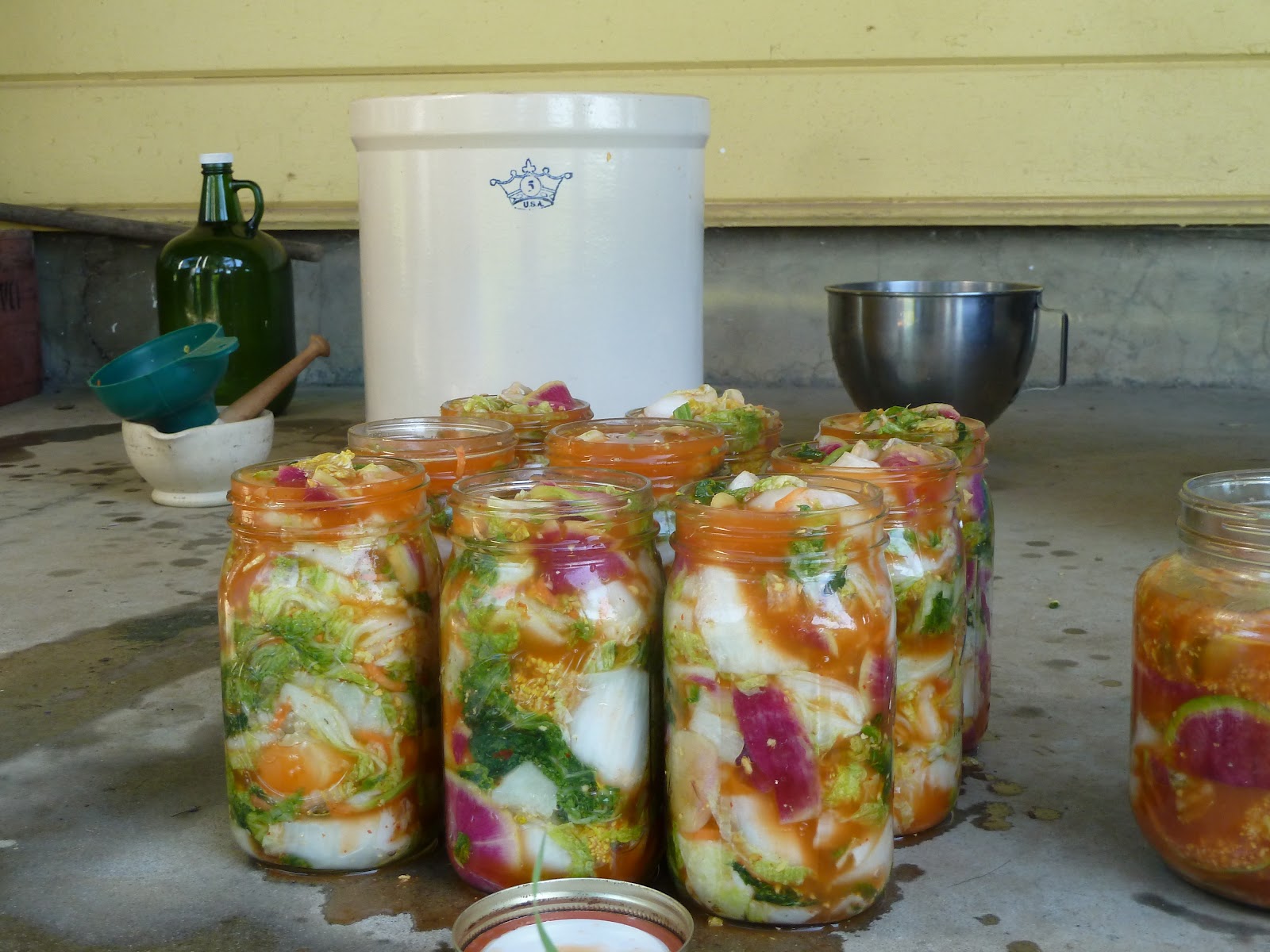
Making Kimchi
Soon after our first failed attempt at fermenting, we discovered a cookbook called Nourishing Traditions by Sally Fallon, where we learned that fermenting foods is not only an age-old way to preserve food, but that the process of fermentation actually makes the food more nutritious.
Different types of fermentation yield different results. With beer and wine, yeast ferments sugars and carbohydrates into alcohol. Another type of fermentation, called lacto-fermentation, uses a bacteria called Lactobacillus to ferment things like milk into yogurt. Malolactic fermentation, which is a type of Lactobacillus fermentation, is part of the secondary fermentation which some wine varieties, such as Chardonnay, go through (that's where Chardonnay can get it's butteriness).

It includes Napa cabbage and watermelon radish
Since we have a big garden, we are always trying to figure out easy, healthy ways to preserve the bounty. So over the years we have learned to successfully ferment the vegetables as a way to preserve them. By trial and error, we have gotten pretty good at making lacto-fermented sauerkraut, pickles, olives, and much more!

This past weekend, the cabbage was turned into sauerkraut and Kimchi (a spicy Korean type of sauerkraut) and the weekend before, we made pickled cauliflower (yum!). If you come by the house, you will almost always find something in the fridge that's been fermented. This might even include several experiments which are sometimes amazing, like green tomatoes, sometimes not, like the unripe nectarines. 

The best recipes for fermented veggies are from a book called Wild Fermentation by Sandor Katz. In his book, Katz reminds us that many of our favorite foods and drinks are fermented including bread, cheese, wine, beer, chocolate, coffee, tea, pickles, sauerkraut, kimchi, miso, soy sauce, vinegar, and buttermilk.
the finished product
And be sure to check out his recipe for the Best Sauerkraut Ever!


Jill Klein Matthiasson