Monday, January 28, 2013

Now We're REALLY Farmers

......a tale that is not for the faint of heart

After years of dreaming of farming, we planted our first fruit orchard (on leased land) in 2004 and harvested our first crop in 2007. We sold the fruit at the Napa Farmers' Market and to local restaurants. In the same year, we moved to our current home vineyard/farm and bought a tractor and some other farming equipment. It was at that moment we started to think we were farmers....until this week....
one day old chicks
Last summer we acquired a few new chickens from some friends who had too many. One of the chickens kept getting out of the fence and then one day we didn't see her anymore, so we assumed the coyotes got her. About three weeks later we were sitting in our yard and here comes the missing chicken with ten newly hatched chicks in tow! We knew the babies wouldn't survive the coyotes for very long, so we brought them into the garage and put them under lights to raise them. 
the proud Papa
When they were old enough, we put them outside to roam around and at night they would go inside an old dog crate that we set up inside the garden fence. They seemed very safe until one morning when a raccoon (we think) got into the garden and stuck it's nose through the dog crate and killed five of the chickens. In was an awful sight to see.

After that we couldn't get the remaining young chickens to go into the crate at night. They would hide and we couldn't find them. We lost two more that way. We were left with three chickens when they were big enough to put with the rest of the flock - two hens and a rooster.
the lone surviving rooster
Since we already had a rooster, we knew we would have to "get rid of" the new rooster at some point. When the baby rooster started going through puberty, the Papa rooster started pushing the new guy out; their little world wasn't big enough for both of them and it was clear that one of them would have to go.

So finally, one morning, we slaughtered the now almost full-sized rooster and cooked him for dinner. Chicken and dumplings to be precise.

When we ate the rooster that was the progeny of our own chickens, the rooster that we had raised, the rooster whose whole life had been lived on our farm, that's when we REALLY felt like farmers. It was very different than eating vegetables from our garden or fruit from our trees or drinking wine from our vineyard (although that is always pretty cool); this animal had been alive and walking around our yard.

So we say Thank You to the spirit of that rooster and all animals that we eat.

Thursday, January 10, 2013

The Ol' Barn Roof

Now that the holidays are over, and we've eaten many wonderful meals and drunk many amazing wines, it's time to get back to everyday life.

The winter means focussing on a lot of projects that we don't have time for once the growing season gets started; at least for now the wines are all put to bed and the grapes are dormant.

When we bought our property, it came with a 100+ year old barn filled with "stuff." Some of that stuff is very cool and some is just junk. Over the years, we've bought some farm equipment (a few tractors, implements for tilling the soil and mowing, etc), adding to the mix of stuff and junk. We actually use some of the stuff that we "inherited" from the barn, like the old manure spreader that Steve unseized with two cans of WD-40. We use it to plant the cover crop every fall.

The barn is about three stories tall. At one time it had a hay loft where all of the hay for the year would have been stored. The story is that the loft was removed to put in the prune dehydrator. Before grapes, two of the main crops in the Napa Valley were walnuts interplanted with prunes. Another thing that we inherited were the fruit boxes that neighbors brought their prunes in which were destined for the dehydrator.

Well after 100+ years the barn roof is now full of holes and all of the valuable vineyard equipment that we've invested in is being exposed to the elements, so we bit the bullet and finally decided to replace the roof....we might have to put off our kids' college just to pay it!

Happy New Year!

All the best,

Steve, Jill and the boys


some old fruit boxes

holes in the old roof


tearing off the old roof


putting on the new one


Tuesday, November 13, 2012

How to Love Wine


Harvest at Matthiasson is officially over! While much of the country suffered extreme heat and storms, we’ve had some of the best weather in years. Spring brought us ideal conditions for pollination of the grapes and fruit trees followed by a summer of nearly perfect weather, and we harvested some of the highest quality and quantity that we've seen in over a decade.

the pantry
Our fruit tree harvest, which began July 1st, went extremely well - demand for the fruit at local restaurants was the highest ever yet we still managed to make a lot of jams. The grape harvest spanned two and a half months and we fermented some exciting new varieties (including Aglianico and our first ever Pinot noir). And last week we picked the first crop of olives from the 55 trees that we planted when we first bought our property five and a half years ago, marking the very end of harvest - it was very exciting to take the olives to the mill for our first estate olive oil!

So this is our life. We mark the passage of time by the agricultural cycle. We grow food and find different ways to process it to preserve the bounty. Making wine is part of that.

In his recent book, How to Love Wine, New York Times wine critic Eric Asimov captured the essence of our life in a passage he wrote about us after a couple of visits. He states, “It’s an almost magical feeling to be sitting with the Matthiasson family around their big, wooden dining table at the center of their residence. Platters of vegetables pickled and jarred by Jill whet the appetite, to be followed by lamb raised and now cooked by the family. Alongside, we drink the wines, both white and red.” He goes on to say, “This is chez Matthiasson, a kind of modern-day ode to the sort of community subsistence farming that defined how generations of Europeans lived their life.” And about our life he states, “It’s a do-it-yourself American ethos that we venerate freely in mythology but rarely in real life….”

He crystallized our effort with our wines by stating, “Most of all, they are alive – not denatured products but living, breathing wines that perhaps achieve this quality by sacrificing predictability.”
It is a great honor to be featured in this book about the author’s personal journey and his commentary about the place that wine fits into all of our lives.

We would encourage you to add How To Love Wine to your winter reading list....we promise that it will make for great reading and will pair nicely with a glass of MATTHIASSON wine!

Thursday, October 18, 2012

What’s Cooking in the Garden?


I would be a terrible teacher. In my mind, the best teachers present information in a neutral, non-judgmental way. For older kids, good teachers provide both sides of a controversial subject and let the kids arrive at their own conclusions.

Not me……Every Fall for the last 10 years I’ve been teaching a class to 2nd and 3rd graders at my kids’ elementary school called “What’s Cooking in the Garden.” There is no objectivity when I teach. I am basically a propaganda machine promoting the importance of growing and cooking your food. Fast food and junk food get a bad rap in my class. The other day I had all of the kids pull out the wrappers from their lunches and read the ingredients. I told them if they couldn’t pronounce the ingredients they shouldn’t be eating the snack. Every snack but one ended up in the garbage. Then we made fruit salad with fresh fruit from the school's garden and they were thrilled.

I keep things pretty simple in the class so the kids can make the same things at home. This week I grabbed some Refosco grapes from our property and made grape juice. Every kid in the class claimed they knew someone who has a vineyard. That’s Napa for you!

There's always several kids who hesitate when we start squishing the grapes because they don’t want to get their hands dirty.  By the end the kids who hesitated the most are the hardest ones to get to stop.
getting their hands dirty

juice was flying everywhere

everyone finally gave in

pressing the grapes to extract the juice

the press cake - everyone loves cake, right?

Cheers!


Friday, October 5, 2012

Our Unsung Heroes

We are very excited to be harvesting our home vineyard today. This is the vineyard that we look at everyday; the vineyard that the kids walk out to to snack on grapes; and the vineyard we hope to pass on to them one day. The folks who come to visit us always get a tour of this vineyard.

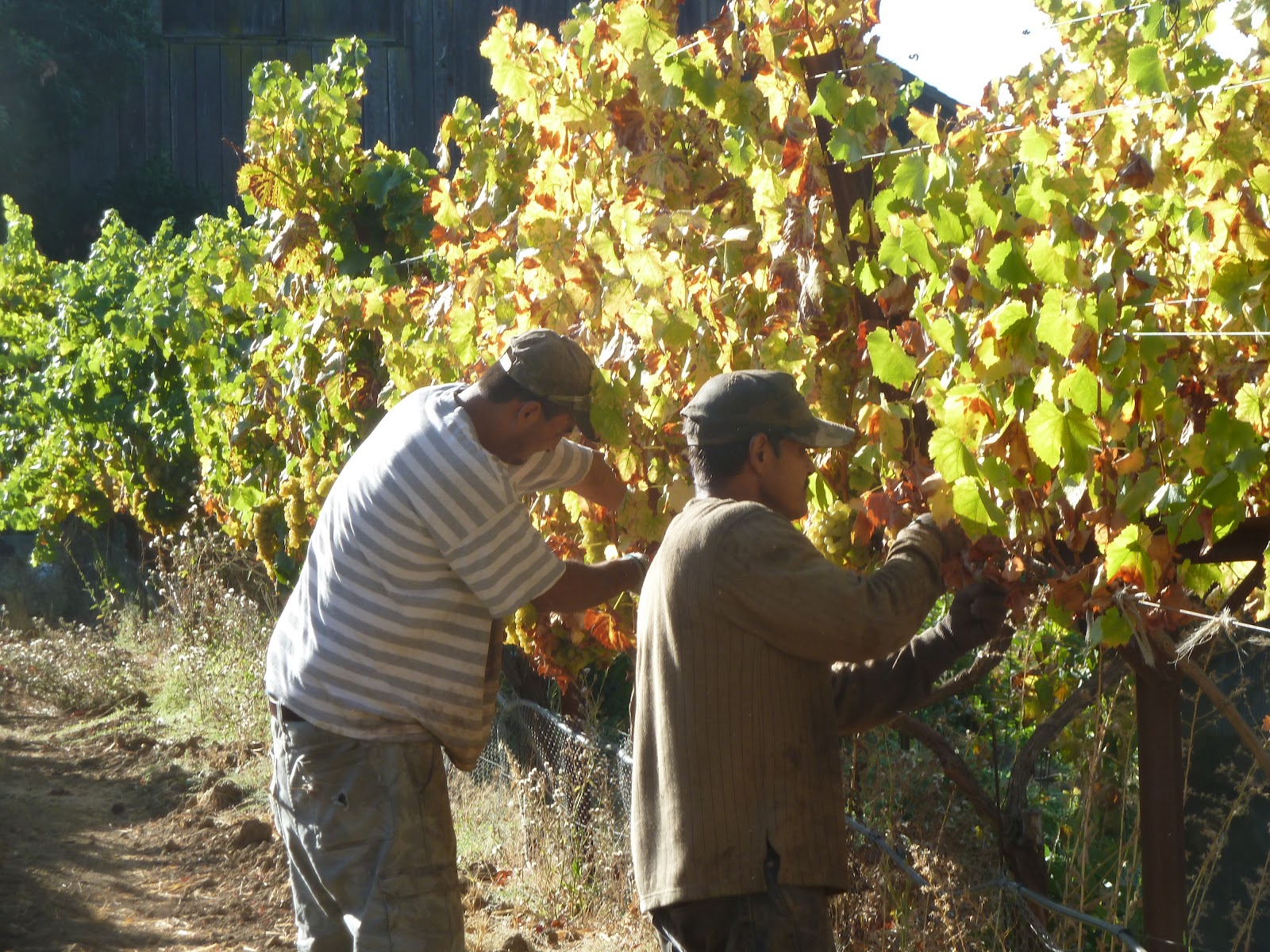
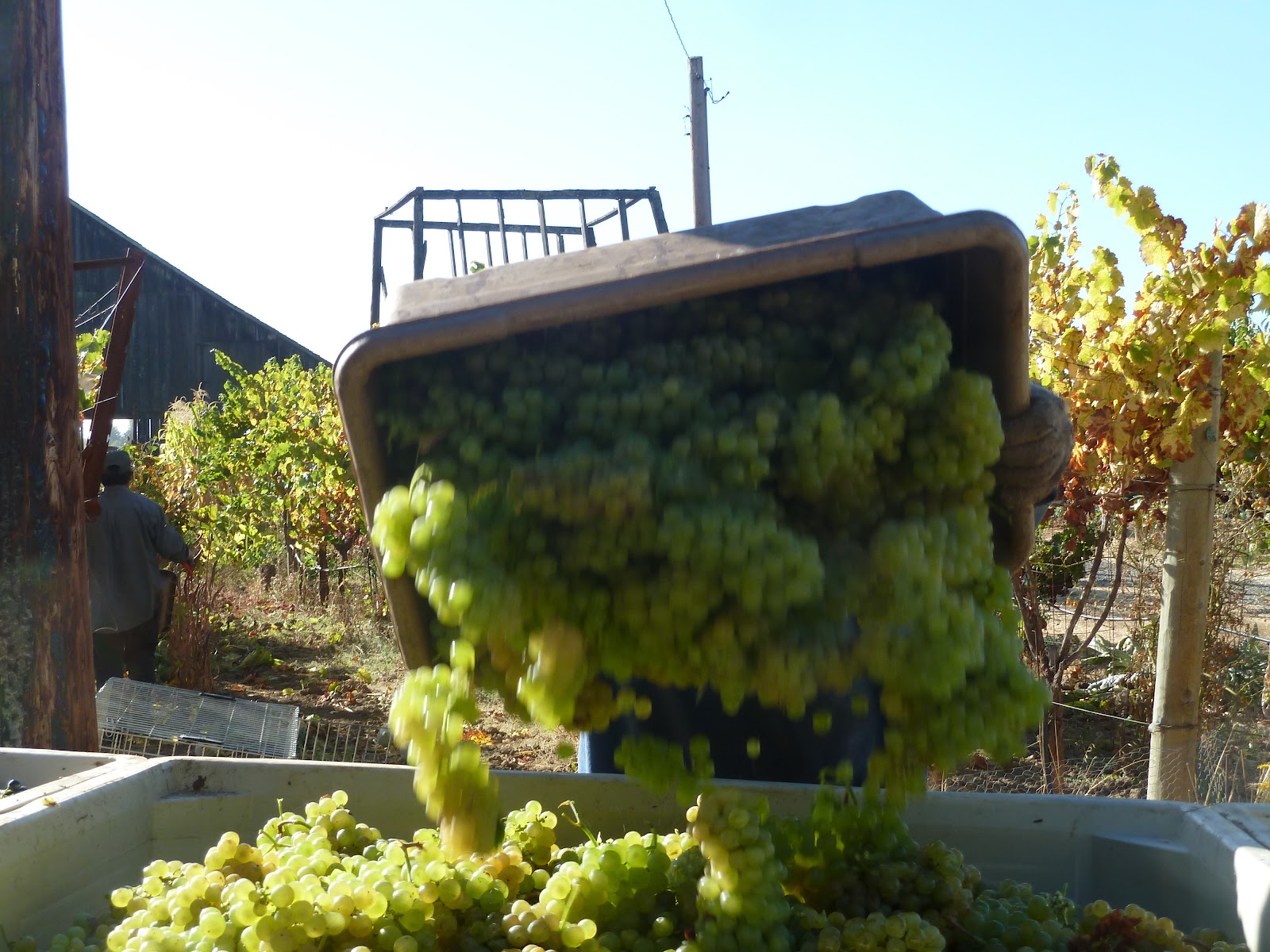
But when I say “we” are harvesting the vineyard, it means that we got the harvest bins over to the property and we removed the shade cloth covering the western side of the vineyard (a family affair till dusk of last night), but the real “we” is really not the Matthiasson clan, but the work crew that we hire to literally do all of the heavy lifting. These guys are our heroes. They are out there right now, in our backyard, working faster and harder than we could ever even imagine working. This is the time of year when they have to make enough money to get them through the period of time after harvest when they get laid off for a few months. They typically start back in January when it’s time to prune. These are not our regular employees, but a crew that we hire a few times a year for the big pushes in the vineyard.

And without these hardworking guys, we would never be able to grow and harvest the grapes. So a big THANK YOU goes out to all of them, especially today, for being a key part of us being able to do what we do.


harvesting Ribolla gialla
the bins they are carrying weigh about 60 pounds when full
Jack, who works for us year round, has been
another invaluable part of our harvest this year


Friday, September 21, 2012

The Forbidden Fruit


From the very beginning the ancients were truly enamored with fruit.  Stories and traditions about human's origins connect him to a garden of paradise filled with fruit trees. The stories are essentially the same whether it be the Semitic Adam, the Teutonic Iduna, the Greek Hesperides, or the Celtic Avalon, in ancient times our idea of paradise centered on an abundance of cultivated fruit, its sensual irresistibility and the consequential calamity of its seduction.

Pink Pearl Apples to be made into Apple Butter
Apples, traditionally recognized as the forbidden fruit, have long been associated with love, beauty, health, comfort, pleasure, wisdom, temptation, and fertility. Apples became involved with many tales of love, bribery and temptation ranging from the abduction of Helen of Troy to the defeat and marriage of Atlanta. The romantic connotations of the apple were powerful reasons why apples came as dessert at the end of the meal.

Genesis depicts Adam and Eve leading the plush life in Eden. They may eat fruit from any tree except one, "the tree of the knowledge of good and evil." However, in the Hebrew text, Genesis doesn't mention apples, only “fruit.” In fact it is unlikely that apples grew in the Middle East during biblical times. It seems that the early Christian scholars took the forbidden fruit to be an apple possibly because the Latin word “malum,” means both "apple" and "evil.” A contributing factor was that apples were a lot more popular in Europe than in the Middle East, where it's generally too hot for them to thrive.

It has been suggested that the forbidden fruit was actually a fig and not an apple. The apple was the favored representation of the forbidden fruit in early Christian art in France and Germany, but Byzantine and Italian artists tended to go with the fig, with Michaelangelo depicting Adam and Eve taking fruit from the forbidden fig tree on the Sistine Chapel ceiling.

Right now our fruit orchard is filled with several varieties of ripe apples and figs. On any given day it’s hard to say which would have been considered the more forbidden. However, in the end I have to vote for the fig. There is something simply luscious about biting into a fresh fig. (See our previous post The Sensuous Fig).

We produce Fig Jam and Apple Butter from our fruit trees for our Wine Club members. Taste these two delicious treats and you can come up with your own conclusion about which of these fruits is the more forbidden.

Tuesday, September 4, 2012

Grafting: Part 3

It's the beginning of September, four months after three varieties of grape budwood were grafted into our vineyard (see previous posts about the grafting: Grafting our Grapes and Grafting Part 2). The amount of growth is pretty amazing in such a short time. Next year we will be able to harvest a small crop off of the newly grafted vines and by the following year, we will get a whole crop.


May 11, 2012 a few days after the vine was grafted
June 11, 2012. the graft has taken and is starting to grow

September 4, 2012. The same vine 3 months later
has grown from 2 inches to 3 feet from the site
of the graft.
Both sides of the vine on September 4

Monday, August 27, 2012

The Dog Days are over (we hope)


The Old Farmer's Almanac lists the traditional period of the “Dog Days” as the 40 days beginning July 3rd and ending August 11th, coinciding with the ancient heliacal (at sunrise) rising of the Dog Star, Sirius. These are the days of the year with the least rainfall in the Northern Hemisphere. Dog Days were popularly believed to be an evil time "the Sea boiled, the Wine turned sour, Dogs grew mad, and all other creatures became languid; causing to man, among other diseases, burning fevers, hysterics, and phrensies." according to Brady’s Clavis Calendaria, 1813. Without sounding too smug, I have to admit that as many of you across the country experienced some form of these hot summer scourges, we here in the Napa Valley had a summer of nearly perfect weather.

at the Napa Farmer's Market

In my last post, all the way back in June, I talked about the glories of the Santa Rosa plum. Though not a great year for plum yields in general, the great weather yielded us amazing crops of white and yellow nectarines, peaches, apples, blackberries, and a few pluots (a cross between a plum and an apricot). The warm, sunny days in the Napa Valley are perfect for bringing out the sugars and the coastal-influenced cool nights are key for bringing out the acidity and unbelievable flavors of the fruit!

an heirloom plum variety called "Howard's Miracle" it has a very floral
 smell and tastes a little like grapefruit.

Many of our favorite Napa restaurants, including OenotriZuzuNorman RosePizzeria Azzurro, and ABC Bakery, used the fruit on salads, in desserts, as pizza toppings, and as a topping for French toast. We also sold fruit at the Napa Farmer’s Market.

The harvest was so bountiful that I was also able to make LOTS of jam, including Peach Raspberry and Heavenly White Nectarine-Ginger, Pink Pearl Apple Butter, and soon I will be picking Mission Figs for a round of Fig Jam.

Baring any unforeseen calamities, we are expecting a great 2012 grape harvest. We will be picking the Sauvignon blanc for our White Wine blend this week. Growing conditions were close to perfect this summer, and we’re looking forward to fantastic quality wines!

Thursday, June 21, 2012

The Santa Rosa Plum

In addition to the 5 acres of grapes that we farm by our house and 20 acres of grapes that we farm on leased land, we also farm two fruit orchards on leased land. We planted the orchards in 2006 and 2007 with peaches, plums, nectarines, pluots (a cross between a plum and an apricot) and cherries, along with apples, Asian pears, figs, berries (strawberries, blackberries and raspberries), quince, lemons and grapefruits. We sell the fruit to local restaurants and at the Napa Farmers’ Market and make jam for our Wine Club members.
orchard in bloom last winter

We planted about 10 varieties of peaches, 5 varieties of nectarines, 10 different types of plums, and 4 different types of pluots. Choosing the varieties was a challenge, and we got advise from friends who were already growing these crops. At least two of the varieties that we planted, the Santa Rosa plum and the Fay Elberta peach, were bred by a brilliant horticulturalist name Luther Burbank.

Santa Rosa Plums
Born in 1849, Luther Burbank, famous for breeding the Russet Burbank potato, the Freestone peach (any peach which comes away easily from the pit or stone), and the Shasta daisy, introduced more than 800 new varieties of plants. Though he is most famous for the potato that bears his name, fruit lovers might argue that his crowning achievement was the Santa Rosa plum. Introduced in 1906, the Santa Rosa is still the gold standard for farmers market plum flavor, though it has fallen out of favor commercially. As late as the 1960s, the Santa Rosa still accounted for more than a third of California's plum harvest; recently, it had dropped to only a percent or 2, as growers have abandoned it in favor of bigger, firmer and often blander fruit. And after you bite into a rich, tangy Santa Rosa, almost anything else tastes insipid.

Besides just eating the Santa Rosa plums when their juices drip down your face, they make the most delicious jam and tarts.
Santa Rosa Plum jam

For the jam, I remove the skins and seeds and put them in a big pot with lots of sugar (to taste). The plums need the sugar to balance their tartness. Add some lemon juice,  cook them down, and put the plum jam in jars….yum…the jam actually tastes a little like our wine!

Plum tarts are magical. Here’s a great recipe:

Poached Santa Rosa Plum Tart

Ingredients
1/2 cup sugar (4-5 Santa Rosa plums)
Superfine sugar for dusting (or finely ground sugar)
Prepared pâte sucrée tart shell (see below)

Preheat oven to 300 degrees. Make simple syrup by combining the sugar with 2 cups boiling water, stirring well to dissolve. (1) Cut the plums in half from stem to bottom, twist halves to separate, place skin-side down in a skillet, and (2) cover with simple syrup. Poach over medium-low heat until tender, approximately 6 or 7 minutes. Let cool for a few minutes, then remove gently onto a plate. Carefully remove the plum skins, keeping them intact, and lay on a parchment-lined baking sheet. Spread each skin flat and sprinkle with superfine sugar (or sugar that has been powdered in a small grinder). Bake at 300 for about 6 minutes, until they start to harden, then flip skins and sprinkle the opposite sides with sugar. Continue baking for another 6 minutes. Remove from oven and let cool, and raise oven temperature to 350. (3) Slice each half-plum into moons and fan over a baked pâte sucrée shell in a rectangular 4-by-14-inch tart pan. Sprinkle top with sugar and bake for 10 minutes at 350. When cool, remove from pan and cut into slices, topping each with a piece of candied skin.  

Tart Pastry (pâte sucrée)
Ingredients
1-1/4 cups all purpose flour
1/3 cup sugar
3/4 cup (1-1/2 sticks) butter, cut in half-inch cubes
pinch of salt
2 egg yolks
1/2 teaspoon natural vanilla extract

In a mixer, or with clean hands, work together flour, sugar, butter, and salt until butter is incorporated, and the texture resembles coarse cornmeal. Form a well in the center of the flour-butter mixture, add the egg yolks and vanilla, and with a fork combine ingredients starting in the middle and working outwards until all is uniform. The dough should be soft; if it is sticky add a bit more flour. Line the bottom of the tart pan with parchment and brush with melted butter. Press dough in tart pan evenly. Prick the bottom of the tart with a fork and refrigerate for 30 minutes. Bake at 325 degrees until firm, but not brown, about 12-15 minutes.

Tuesday, June 12, 2012

Grafting Part 2

One month later and the grafted vines have started to grow and even produce little bunches of grapes. We will pull these off so the vines can put all of their energy into growing.
Though the amount of new growth is different on each vine, they were all grafted on the same day

This variety is called Schioppettino

Schioppettino is typically grown in the Friuli region of Italy

we are the only vineyard/winery growing Schioppettino in the US